
Bambu Lab H3C: Nine Tools, More Possibilities, and a Different Approach to 3D Printing
Bambu Lab’s new H3C brings nine-tool printing, faster material changes, color blending, and improved flexible-filament support to one machine. Here’s a look at its standout features, who it’s built for, and what makes this $2,499 printer worth watching.
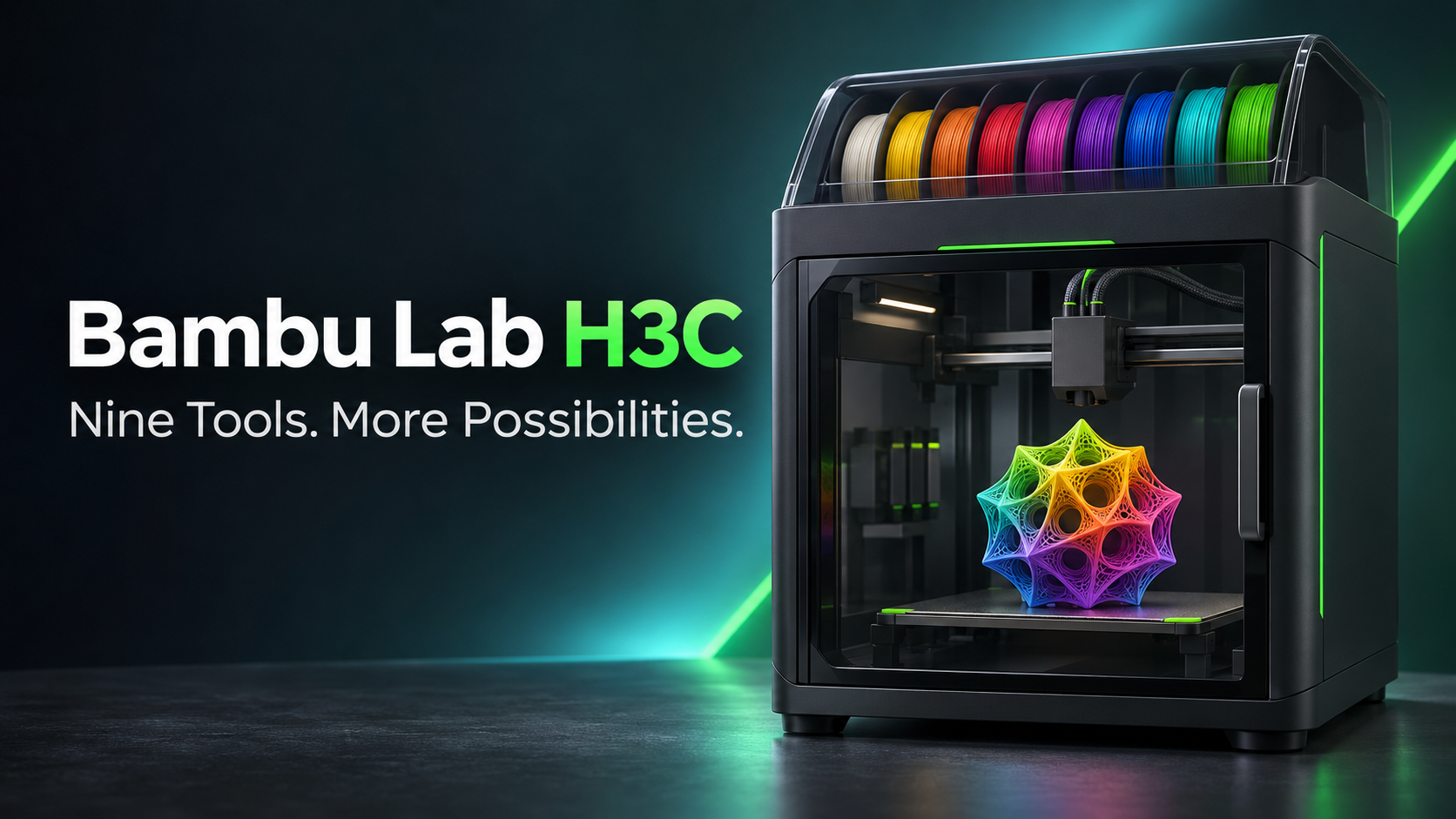
One of my favorite things about 3D printing is watching an idea become something you can actually hold. But once you move beyond basic prints, the compromises become obvious. Adding colors can mean longer print times and wasted filament. Fine details can slow an entire project down. Flexible materials introduce another set of challenges. The new Bambu Lab H3C takes aim at those frustrations. Announced November 3, 2026, it introduces a nine-tool system designed to make switching materials faster and more practical. The H3C AMS Combo launches at **$2,499 in the United States before tax**, putting it firmly in enthusiast and professional territory. What interests me most is how those tools could change the projects people choose to make. The Biggest Difference: Nine Dedicated Print Tools The H3C’s defining feature is **Swaptek**, Bambu Lab’s tool-changing system. A conventional single-nozzle multicolor setup has to unload one filament, feed in another, and purge the previous material. The H3C instead uses nine independent print tools, each with its own filament path and heating system. Bambu says material changes take **under six seconds**, including minimal priming. Its Active Pre-Heat system looks ahead in the print instructions and warms the next nozzle while the current tool finishes working. That matters because a complicated model can involve hundreds of changes. Small delays become a substantial part of the total print time. My takeaway is that the H3C’s strongest advantage should appear on projects with frequent material changes. A simple, single-color bracket gives that system much less opportunity to prove its value. Color Printing Goes Beyond Nine Spools Bambu is also promoting color blending using **cyan, magenta, yellow, black, and white filament**. Carefully calculated layers create additional shades and gradients, rather than requiring a separate spool for every visible color. This is a layering technique, rather than liquid inks mixing inside a print head. For decorative models, signs, and display pieces, that opens up an appealing possibility: more visual variety from a smaller selection of base colors. The results are something I would want to examine closely in person, particularly on curved surfaces and small details. Color range is exciting, but consistency and surface finish matter just as much. Different Nozzle Sizes in the Same Print Another standout capability is using different nozzle sizes within one project. Bambu describes a larger nozzle handling the bulk of a model while a smaller nozzle prints the detailed sections. That is a useful approach to a familiar tradeoff. Choosing a tiny nozzle for a detailed section can otherwise mean accepting that slower process across the entire object. For something like a custom enclosure with fine lettering, the potential benefit is straightforward: put precision where it contributes to the finished piece. Better Support for Flexible Materials The H3C’s **FlexFeed extruder supports both 1.75 mm and 2.85 mm filament**. Bambu’s dedicated thicker TPU path is designed to resist buckling and handle material as soft as 75A. The company claims up to three times the TPU flow rate of a conventional printer under its stated comparison. This could be especially interesting for grips, cushioning, wearables, and other parts that need flexibility. Combining material properties is arguably more useful than adding colors alone. A rigid component with a comfortable contact surface solves a different kind of problem than a decorative print. The Main Specifications | Feature | Bambu Lab H3C | Build volume | 330 × 320 × 325 mm | Maximum nozzle temperature | 350°C | Maximum bed temperature | 120°C | Active chamber heating | Up to 65°C | Supported nozzle sizes | 0.2, 0.4, 0.6, and 0.8 mm | Included nozzle material | Hardened steel | Advertised maximum movement speed | 1,400 mm/s | Maximum acceleration | 25,000 mm/s² These are manufacturer specifications; maximum movement speed does not represent the speed of every printed feature. Filament Storage Is Part of the System The integrated **AMS 3H** stores and feeds nine spools inside an enclosed system. It also includes two dedicated drying positions, with drying temperatures up to 85°C, and can dry filament while printing continues. That distinction matters: nine stored spools does not mean nine actively heated drying positions. For users moving between different materials regularly, having storage, feeding, and drying coordinated within the printer could reduce some of the preparation surrounding each job. Who Is It Really For? Based on its design, I see the strongest fit for makers producing complex multicolor models, designers experimenting with flexible and rigid components, and small businesses that regularly lose time to material changes. For someone printing occasional organizers or basic household parts, the purchase is harder to justify. The useful question is whether your projects would regularly benefit from the extra tools. I would also want to assess long-term maintenance, replacement-tool costs, actual waste, and reliability across extended jobs before calling it an automatic upgrade. What Makes the H3C Worth Watching The H3C brings several capabilities together: fast tool changes, mixed nozzle sizes, flexible-material support, and integrated filament management. For me, the appeal is the possibility of designing a project around the finished result with fewer compromises during printing. The specifications make an ambitious case. The real test will be how consistently the machine delivers those benefits in everyday use—and whether the time and material it saves justify the investment.
What do you think?
Loading conversation…